Table of Contents
- A short history of Spaced Repetition
- How Frazely uses the Spaced Repetition System
- Why I think SRS is essential
Hi, I’m Aleksandra, the creator of Frazely. I’ve spent many years of my life learning languages - testing apps, trying methods and making mistakes. I discovered that efficient language learning has a lot of science behind it, and one of my most important findings is that there’s an algorithm that can make you remember words dramatically faster and for much longer.
It’s called spaced repetition, and ever since I discovered it, it’s been a non-negotiable part of how I learn. What shocks me is how few language apps actually use it, and how many learners have never even heard of it.
So today I want to show you exactly how I built it into my app, and how Frazely helps you remember words - faster and forever.
A short history of Spaced Repetition
The man who tested his own memory
Let me tell you about a German psychologist who spent five years testing his own memory.
In the 1880s, Hermann Ebbinghaus sat alone in his study and memorized thousands of nonsense syllables - random combinations of letters like “WID” or “ZOF” that meant absolutely nothing. Then he tested himself after different time intervals to measure how quickly he forgot them. He did this obsessively, for years, on himself.
What he discovered was uncomfortable. Without any attempt to review, we forget roughly half of what we learn within the first hour. Within a day, that rises to 70-80%. The pattern he plotted became known as the forgetting curve - a steep drop that flattens only when we actively intervene.
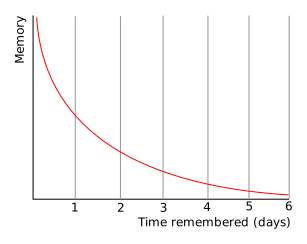 The forgetting curve - we forget up to 80% of what we’ve learned within a single day; unless we review it (source: Wikipedia)
But Ebbinghaus also found something hopeful, that is - every time you review something, the forgetting slows down. The curve gets flatter and your memory gets stronger. And what’s most important - you don’t need to review constantly (for example reviewing all your words every single day). You just need to review at the right moments, that is - right before you forget.
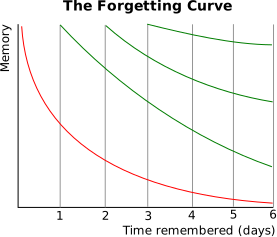 The forgetting curve but with spaced repetition - every time you review a word you forget it slower (source: Wikipedia)
If you review a word too late, when it has already faded from your memory, you lose the progress you’ve made before. And if you review too early - well, that keeps the word in your memory, but makes your learning less efficient. Why waste time reviewing words that are still fresh, right? The key is to review in the exact right moment.
This is the principle behind spaced repetition.
From Ebbinghaus to a cardboard box
In 1972, a German science journalist named Sebastian Leitner figured out how to make the use of Spaced Repetition algorithm practical.
His system was simple - take a cardboard box, divide it into compartments, and put all your flashcards in the first one. Every time you answer a card correctly, it moves to the next compartment - reviewed less frequently. Every time you get it wrong, it goes back to the beginning.
 The Leitner system - every time you answer a card correctly, it’s moved to a ‘review less frequently’ box (source: Wikipedia)
Cards you struggle with will come up every day. Cards you know well will come up once a week or once a month.
For how powerful it is, it actually seems very simple. But it works because it forces your brain to retrieve information at exactly the moments when it’s starting to fade - which is precisely when retrieval is most valuable for long-term memory. Not too early and not too late.
Anki and the digital revolution
Leitner’s system worked beautifully with physical cards. The problem was that managing dozens of boxes across thousands of words eventually became its own full-time job.
In 2006, a developer named Damien Elmes built Anki - a free, open-source app that digitized the whole thing. Anki is extremely powerful, and loaded with options. You can customize exact intervals between reviews, adjust the algorithm to your preferences, track detailed statistics, and build decks (lists of flashcards) for anything. When someone tells me he uses Anki, I know he’s a serious language learner.
But Anki has one big problem - it requires you to build and manage your own flashcards. For language learning that means creating a card for every word you want to learn, finding example sentences, adding audio, setting intervals. There are some public decks available, but they are limited, and you can’t always trust their quality.
Now imagine if there was an app that connects the power of Spaced Repetition with plenty of useful, reliable materials to build your flashcards from… And, oh my gosh…! Imagine if you could do it with a single click… ;-).
How Frazely uses the Spaced Repetition System
I designed Frazely’s review system to give you the full benefit of Spaced Repetition without the extra work.
Every word you encounter in Frazely - whether from our structured courses or from tapping an unknown word in our graded readers - gets added to your personal word list immediately. You can see everything in the Words tab, where each word is labelled as Learning, Mastered, or Difficult. You can also see your reviews scheduled for today in this tab.
From the moment a word is added, the system takes over - there’s nothing you need to do.
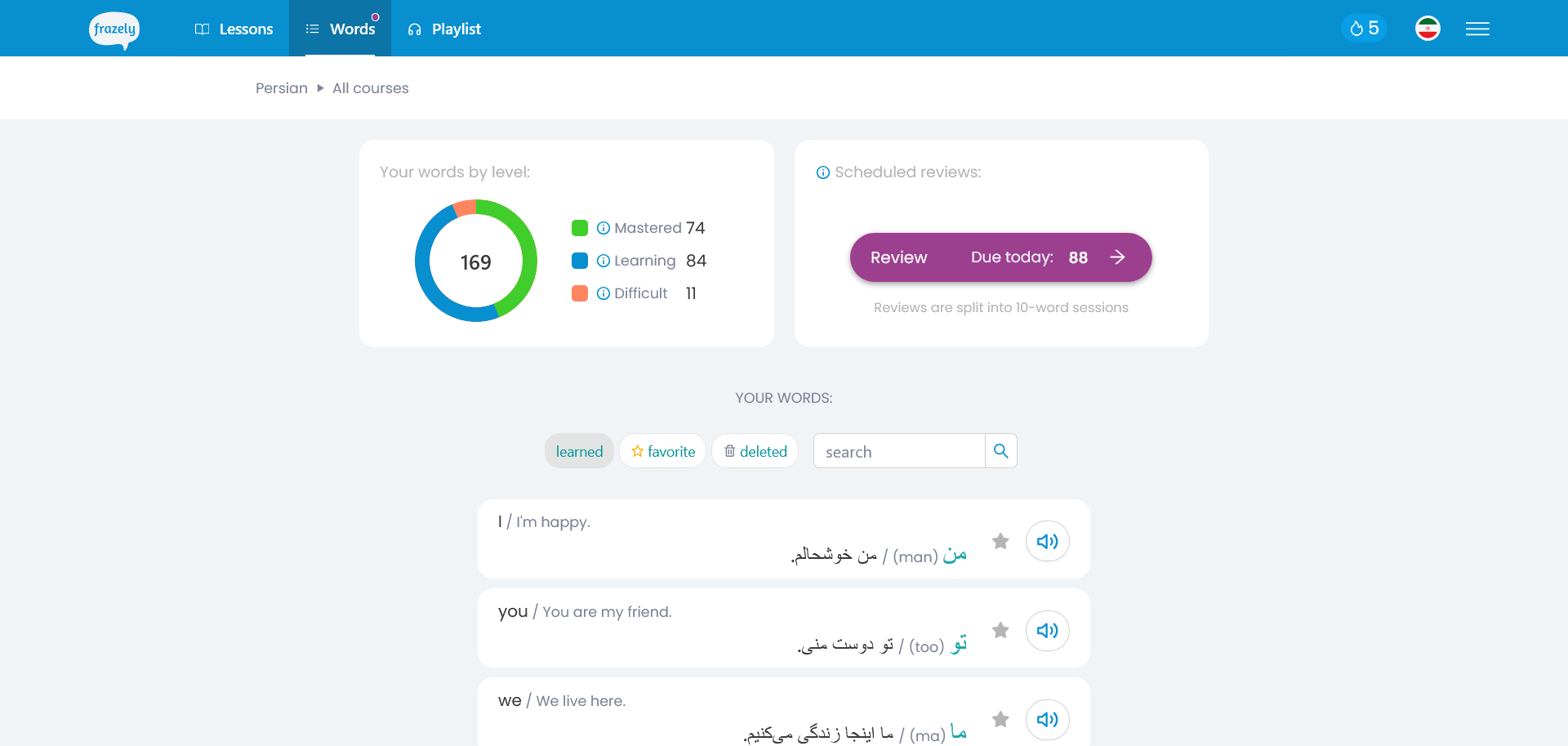 The “Words” tab in Frazely - here you can see all your words by level, and the reviews scheduled for today
Scheduled reviews
In the Words tab you will see a purple button with your daily scheduled reviews. The Due today number is the number of words that, according to the algorithm, you are just about to forget. This is a personalized recommendation based on your previous reviews of every single one of these words. To keep your learning most efficient, you should review your due cards every day.
IMPORTANT: When you learn a new word, it immediately appears in your reviews as due today. This is because even if you just learned the word in the lesson, that doesn’t mean you actually remember it. So it’s always a good practice to review your new words at the end of your learning session.
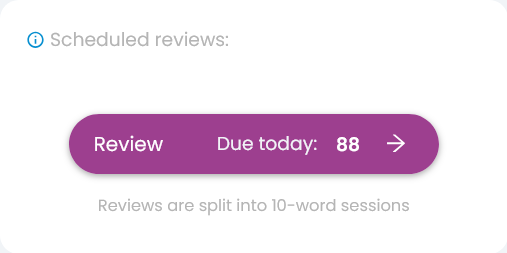 The “Due today” button in Frazely shows you the words you are just about to forget
When you click on the Review button, you get your personalized review session created for you. Here you can choose from among five exercises to best fit your learning style.
Depending on whether you know the answer or not, the algorithm will follow a different path:
The “I know it” path
Each of your words is placed on a level - from level 0 to level 7. Every time you tap I know it, the word moves to the next level and the next review gets pushed further into the future.
Here are the exact time intervals that Frazely uses when scheduling the reviews:
- New word is added - Level 0
- Level 1 - Review in 1 day
- Level 2 - Review in 1 day again
- Level 3 - Review in 3 days
- Level 4 - Review in 7 days
- Level 5 - Review in 14 days
- Level 6 - Review in 45 days (1.5 months)
- Level 7 - Review every 1.5 months forever → word is Mastered
PS. Don’t worry if that’s a bit overwhelming. I just wanted to give the details to satisfy the most curious learners. You don’t need to remember the details or adjust anything. The algorithm is fully automated. All you need to do is finish your daily reviews :).
Once a word is Mastered, it doesn’t disappear. You’ll still see it every 45 days - roughly once a month and a half. Not to reteach it, just to keep it alive. Because knowing a word isn’t only remembering the meaning. It’s also the spelling, the context it appeared in, the sentence it was part of. Occasional exposure keeps all of that fresh. And once you know a word very well, a review takes literally a second.
The “I don’t know” path
If at any point you tap I don’t know, no matter how many times you’ve reviewed the word before, the word is marked as Difficult and its level resets to zero:
- Word at any level
- Click - “I don’t know”
- Word marked as “Difficult” and level set to 0
- Review scheduled for tomorrow
All previous progress on that word is lost. You’re starting from the beginning. This might sound harsh, but it reflects how our memory works. If you can’t recall a word, you don’t really know it yet. The only way forward is to relearn it properly. Difficult words will naturally come up more often until they stick - which is exactly the point of Spaced Repetition.
Your words by level
In the Words tab you can see the total number of your learned words, as well as your words by level. There are three levels - Difficult, Learning and Mastered.
Difficult words are the words you couldn’t recall in your last review. You will see them again tomorrow. And if tomorrow you answer them correctly, they will move to the Learning category.
The Learning category contains words that you know at this moment, but that are not yet saved in your memory forever. This includes words from levels 1 to 6.
Your Mastered words are the words you rememebered during your last 7 reviews. They are safely stored in your long-term memory. You will still see them sometimes, but the risk of ever forgetting them is very low.
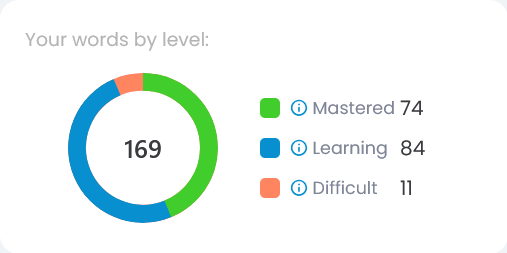 All your words are categorized by level - Difficult, Learning and Mastered
Why I think SRS is essential
Memorizing vocabulary is a long process, not a one-time encounter. Especially when you’re learning a completely new language, your brain needs many repetitions before a word truly sticks. Each repetition strenghtens the memory a little more, making the word a little more automatic. Without a spaced repetition system, words you learn today will mostly be gone within a week. You’ll feel productive during your sessions and make no real progress over months.
It’s common to see stories of avid Duolingo users, who have been learning a language for years, and still can’t hold a conversation - not because they’re bad at languages, but because the app never gave their memory what it actually needs. Duolingo uses repetition too, but it’s not true spaced repetition. Words come back based on fixed lesson, not on your actual recall history. Your learning is not personalized to your memory strength, which makes it less efficient. The result is that you review words you already know while forgetting words you’ve seen once and never again.
That’s why, when building Frazely, I made Spaced Repetition one of its core functions. I literally cannot imagine a good language app without it. And I hope that now that you know the science behind it, you agree.